Wednesday, 18 June 2014

Logan Botanic Garden, Port Logan, Scotland

Back in March I spent a few days over in Scotland and finally, after many years of trying had finally managed to arrange my time to allow long enough to spare a few hours to visit Logan botanic garden before getting the ferry back to Ireland.
It's a bit out of the way, being situated near the west coast in Dumfries and Galloway, south of Stranraer. Its positioning means that it is washed by the warmth of the gulf stream, a warm current of waters that originates on the opposite side of the Atlantic off the coast of Florida. It's due to the Gulf stream that the northerly latitudes of Europe have much more moderate winter temperatures than would be expected for an area as far north as southern Alaska and means we can grow many unexpected exotics.
Originally part of the next door Logan estate, Logan botanic garden became a regional garden of the Royal Botanic gardens of Edinburgh back in 1969, one of three satellite gardens in Scotland that they have taken over responsibility for.

I love the architecture in this area, small whitewashed stone cottages, similar to what we'd have at home.

Fatsia polycarpa,  matt leaves which much more deeply indented than F japonica.

 Shefflera taiwaniana, I wonder if these have been pinched/pruned every so often to encourage branching.

I was intrigued by these boxes, sheltering something from the winter weather, but despite trying to peak through I was unable to work out what exactly they were protecting.

I really liked this urn built from pieces of slate, perhaps something to attempt at some point in the future.

Turning around and looking in the other direction there was a large cord tree Carmichaelia/Chordospartium stevensonii

This New Zealand native is quite rare in the wild due to habitat loss, I'd like to see it covered in its mauve flowers some time.

 In a protected corner near the cafe (yes, I partook in cake) Aechmea distichanthia seems to be doing relatively well.

and a Protea was thinking about blooming as well, though it's a bit of a wonky grower.

I've a bit of a thing for Eucalyptus trees, just don't ask me to attempt to identify them.


Especially ones with long slim Willowy leaves.

 In contrast this Ilex had very large exotic leathery leaves.

Wollemia nobilis has established well and is shooting for the sky. I was actually surprised at just how slim it was.

I'm mad for Cordyline indivisa, the broader the leaves the better, but it's tricky in many parts. Not too warm, and not too cold, not too dry and not too wet, as a consequence it is very prone to dying. They do well in mild wet areas of Britain and Ireland.

Polyelpsis australis native to South America and reputedly is the worlds highest altitudinal (is that a word?) woody plant. It's a member of Rosaceae and has lovely rufus coloured shaggy bark, this one needed a bit of propping to stop it form keeling over.

I can't quite make up my mind about Restios. I like them, but they can look quite untidy at times.

Saying that, the colours of  the base of the shoots is stunning

Rhododendron sinogrande was thinking about doing its thing.

Any ideas what this silvery shrub is???

Hakea epiglottis was giving me a serious case of the lusts.

Winter wrapping was still in place, protectively swaddling the Cyathea dregei plants.

Brahea armata looked good,still  snuggled down but getting ready to wake up for spring.

I've haven't managed to overwinter Fascicularia bicolor subsp bicolor, but then my attempt did coincide with pretty low winter temperatures a few years back.

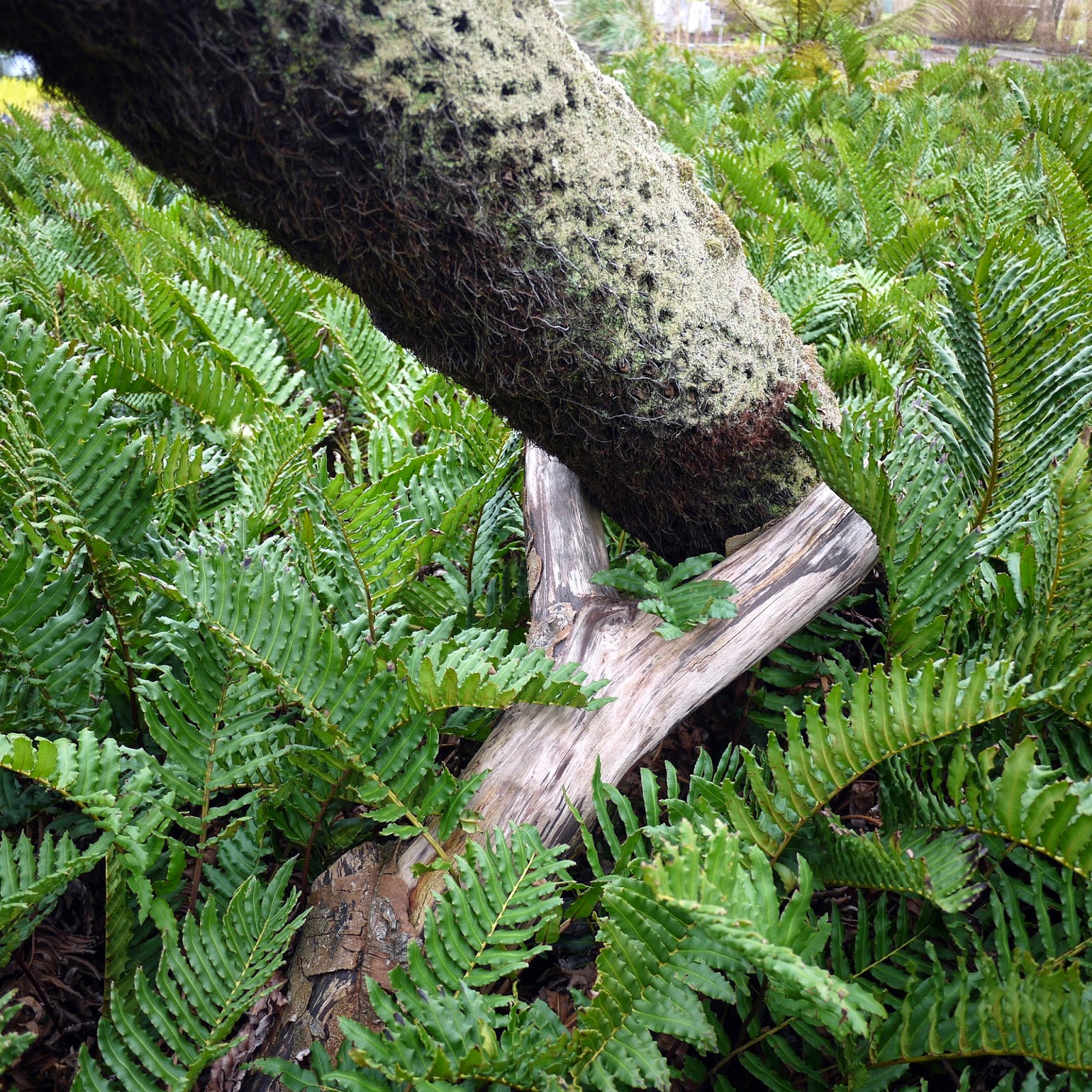
The Dicksonia antarticas were on a primordial scale, with a mass underplanting of Blechnum chilense.

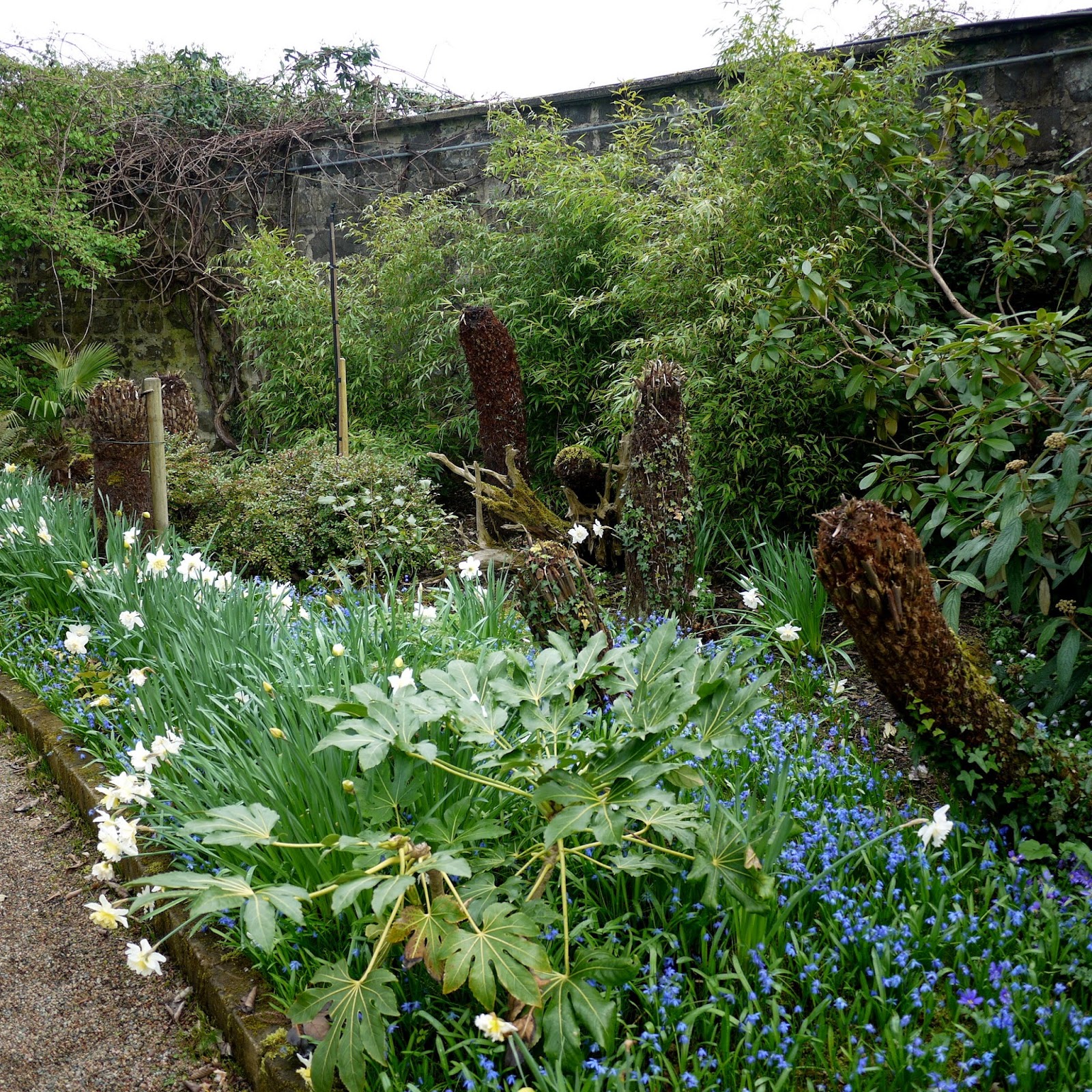
The leaning trunks looked great.

As did the props.
Tetrapanax aren't rare in exotic gardening circles any more, but I still love coming across them. The new growth looking like golden hands as they expand-to monsterous proportions.

Despite the relatively windswept position the Trachycarpus fortunei looked surprisingly good.

As you can see it's very open to westerly winds blowing in from the Irish sea in the distance.

I couldn't get a decent picture of Drachophyllum arboreum, but trust me, it's one hot plant.


Lagarostrobus frankliniim, a conifer with cool flailing branches going off in all directions.


 I want to get my hands on Pyrrosia eleagnifolia!

Its rhizomes snaking over the surface of a Dicksonia antartica whose trunk it is blanketing.

 Sophora tetraptera, the pea flowers are a harsh yellow but it's amazing to have such exotic, waxy blooms this early in the year.

More treeferns

A triple trunker, something you don't see to often.

Hairy Magnolia buds

Purple peeping through

  and bursting out all over. Magnolia campbellii subsp. mollicomata 'Lanarth'

We've many venerable old Cordylines like this in coastal areas of Ireland, but you still have to stand in awe when you see them.

and then we're back at the entrance with another mass planting of Trachycarpus.

Despite it being so early in the year there was still plenty to see, now I just have to try to get over in summer some time soon.


Thursday, 1 May 2014

Ulster Alpine Society spring show

When April comes around it's time for the Alpine society's spring show at Greenmount College outside Antrim town.
Among other disciplines Greenmount teaches Horticultural courses so I was interested to see what the grounds were like as well as attending the show.
The  area used to be a large estate owned by the Thompson family with the manor house dating from the 1820s

After changing hands it was sold to the Goverment in 1910 where it was transformed into an agricultural college.
I do like a good weeping Ash, Fraxinus excelsior 'Pendula', they've a bit of an Addam's family look to them.

The college buildings are the usual uninspiring utilitarian architecture that you'd expect from a school campus. With the usual boring shrub collection.

But what's that on the gable wall?


Ahh, a green wall. Kind of.


Some plants appear to have done very well, others not so good. It doesn't really stand up well to close (or distant) scrutiny but perhaps that's unfair after taking a winter bashing.


The Dianthus looked relatively happy

As did the Ivy, but I did kinda wonder what the point of Ivy in a green wall is, surely you could just grow it on the wall without all this palaver.

The reason for the show is a competition between entrants for the best plant in each category. I personally go more for the members' sale, as you can pick up all sorts of unusual plants, as well as peruse the stalls of the nurseries who sell their wares.
Despite arriving at opening time I'd already missed out on the pick of the plants as a group had swooped in early, bought the most choice plants and promptly left. 
Still, no matter, I was happy with what I got on the day.


Woodwardia unigemmata at the back, a stunning fern. I've got one that needs to find a suitable spot in the garden, but it has a BIG wingspan.
A cute little Primula.

Rather worryingly I seem to be increasingly attracted to 'old lady' plants, so this auricula came home with me. It has a really nice incense type scent.

 These small uns were little larger than a finger nail.


I spent a happy half hour going through the Scottish Rock Garden Club seed list and picked out a few interesting bits and bobs.

Now onto the main hall to view the plants on display.

 Being April, Trilliums feature heavily.

 I loved thus unnamed Saxifraga species

Its purple bobbly flowers

and tiny silvery leaves


Celmisias are cool little plants, I could see myself building a collection of these in future years

 Yes, it really was that golden!


and a fine leaved silver species

Cute little Narcissus

I had lust for this dark Fritallaria affinis var. tristulis

and Tropaeolun azureum looked good

I find it hard to believe that it's a Nasturtum, but of course it is.

I spotted this small Astelia nivicola and immediately thought of Dangergarden for some reason.

Gypsophila aretioides 'caucasica'

A really nicely scented Paeonia broteroi

and a Soldanella carpatica x pusilla grown to perfection and covered in hanging blooms

Pleione shantung

Afterwards I went for a quick walk around the walled garden, it's all very neat and tidy and I realise it was early in the year, but I was kinda expecting a bit, you know, more. 
I'm sure they're turning out excellent well qualified pupils but there was little in the grounds to inspire or excite.

The Dicksonias suffered like so many others from the bad winter a few years back and still haven't been removed.

This golden leaved Symphytum really stood out among the greens, I wonder if it holds onto the vibrant yellow or if it fades through the summer. 


 The glasshouse in the formal walled garden is quite a grand structure


Mind how you go!


As I left I noticed a drift of Muscari latifolium which were flourishing and alive with bumble bees.
*Note to self must get more of these.


Wednesday, 12 March 2014